connectors

connectors are silent heros, taking a group of unrelated parts and bringing them together into a meaningful object. They allow different substances to interact with each other, they negotiate opposing needs and bridge conflicting axes.

Cobalt Network, 2025
3d printed & glazed stoneware glazed with 13 distinct cobalt-based glazes. carbon fiber tubes
Prototype for Cobalt Network
including aluminium, vulcanized fiber, Garolite, carbon fiber, cherry, steel, acrylic and petg
including aluminium, vulcanized fiber, Garolite, carbon fiber, cherry, steel, acrylic and petg

Consider clay as a connecting substance: in its plasticity it’s able to take whatever shape it’s molded into, lending itself perfectly to the formal needs of other substances and parts. In its transformation into ceramics, it captures the soft yeilding shape and converts it into a relentlessly hard and dense connector.


connector (Tenmoku tumbleweed) 2025
3d printed & glazed stoneware, maple, petg.
model for Tenmoku Tumbleweed
2025
petg and poplar
2025
petg and poplar


connector (Black Radiant Node)
2025
3d printed & glazed stoneware, maple and permanent marker
2025
3d printed & glazed stoneware, maple and permanent marker
this series of objects was assembled of (semi) standardized parts and 3d printed clay connectors.
In order to print these irregular ceramic objects, a clay specific support material was developed. This calcium based substance can be printed with the parts and will desolve away after the firing process. This supporting process is what allowed printing forms that do not have a flat bottom, as most clay 3d prints do.

black radiant node after 3d printing. the thin layer of light-colored disolvable support material is visible between the object and it’s supports.


3d printed & glazed stoneware, aluminium and TPU
Proceedural modeling via Grasshopper was used in these objects to generate structurally-sound and 3d-printable connector forms.

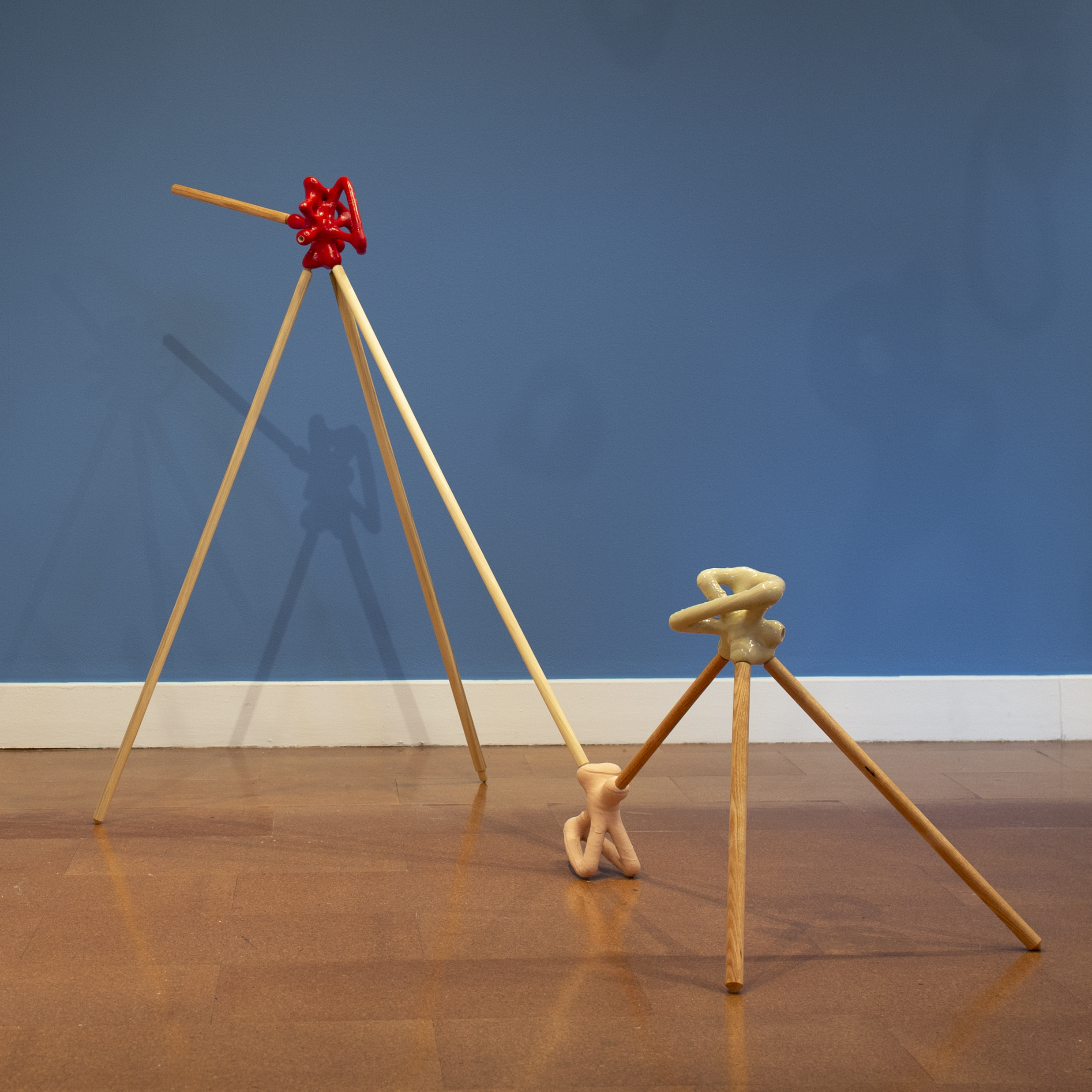
red node for Network1
2022
3d printed & glazed porcelain
2022
3d printed & glazed porcelain
untitled (Network1)
2022
3d printed & glazed porcelain, oak and poplar
2022
3d printed & glazed porcelain, oak and poplar